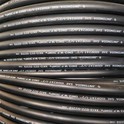
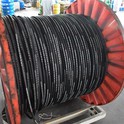
As a supplier of Rubber Hose EN857, I often get asked this question: Can Rubber Hose EN857 be bent easily? Well, let's dig into this topic and find out.
First off, what is Rubber Hose EN857? It's a type of hydraulic hose that meets the EN857 standard. This standard specifies requirements for two - wire braid reinforced and four - wire spiral reinforced hydraulic hoses. These hoses are widely used in various hydraulic systems, from construction machinery to industrial equipment.
Now, the ease of bending a Rubber Hose EN857 depends on several factors. One of the most important factors is the construction of the hose. There are different types of Rubber Hose EN857, like the Rubber Hose 2SC, Rubber Hose 4SP, and Rubber Hose 1SC.
The Rubber Hose 2SC is a two - wire braid reinforced hose. The braid construction gives it a certain degree of flexibility. Compared to some other types of hoses, it can be bent relatively easily. The braided wires provide strength while still allowing for some movement. You can bend it to fit around corners or into tight spaces in your hydraulic system. However, there are limits. If you bend it too sharply or beyond its recommended bend radius, you can damage the internal structure of the hose. This can lead to issues like reduced flow capacity, increased pressure drop, and even premature failure of the hose.
On the other hand, the Rubber Hose 4SP is a four - wire spiral reinforced hose. The spiral construction makes it stronger and more suitable for high - pressure applications. But this also means it's less flexible than the 2SC hose. Bending a 4SP hose requires more effort. The spiral wires are designed to handle high pressures, and they resist deformation. So, while you can bend it, you need to be more careful and make sure you're within the specified bend radius. If you try to force it into a bend that's too tight, you might cause the wires to shift or break, which can compromise the integrity of the hose.
The Rubber Hose 1SC is another option. It's a single - wire braid reinforced hose, which generally offers more flexibility compared to the 4SP but might be less strong than the 2SC in some cases. It's a good choice when you need a hose that can be bent easily for less demanding applications.
Another factor that affects the bendability of Rubber Hose EN857 is the material of the rubber. Different rubber compounds have different properties. Some rubbers are more flexible, while others are more rigid. The flexibility of the rubber can also change with temperature. In cold temperatures, rubber tends to become stiffer, which makes the hose harder to bend. So, if you're working in a cold environment, you might need to take extra precautions when bending the hose.
The size of the hose also plays a role. Smaller - diameter hoses are usually easier to bend than larger - diameter ones. A smaller hose has less material to move around, and the internal structure is more compact. So, if you need a hose that can be bent easily, you might want to consider a smaller size, as long as it meets the flow and pressure requirements of your hydraulic system.
When it comes to bending the hose, it's important to follow the manufacturer's guidelines. Each type of Rubber Hose EN857 has a recommended minimum bend radius. This is the smallest radius that the hose can be bent without causing damage. You can usually find this information in the product documentation or on the manufacturer's website. Using a bending tool can also help. A bending tool ensures that you bend the hose at the correct radius and with the right amount of force.
In practical applications, being able to bend the hose easily can save a lot of time and effort. For example, in a construction site, if you can quickly bend the hose to fit into a new hydraulic system configuration, you can get the equipment up and running faster. In an industrial setting, a bendable hose can make maintenance and repairs easier. You don't have to disassemble large parts of the system to replace or adjust the hose.
But we also need to balance the ease of bending with the performance requirements of the hose. A hose that's too flexible might not be able to handle high pressures, and a hose that's too rigid might be difficult to install. That's why it's crucial to choose the right type of Rubber Hose EN857 for your specific application.
If you're in the market for Rubber Hose EN857 and need help deciding which type is best for your needs, whether you need a hose that can be bent easily or one that can handle high pressures, I'm here to assist you. We have a wide range of Rubber Hose EN857 products, including the Rubber Hose 2SC, Rubber Hose 4SP, and Rubber Hose 1SC. Our team of experts can provide you with detailed information and advice on installation, maintenance, and usage.
Don't hesitate to reach out if you're interested in purchasing Rubber Hose EN857. We can have a discussion about your requirements and find the perfect solution for your hydraulic system. Whether you're a small - scale industrial user or a large - scale construction company, we have the products and expertise to meet your needs.
References:


- Hydraulic Hose Handbook - Industry standard publication on hydraulic hoses
- Manufacturer's product documentation for Rubber Hose EN857