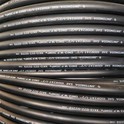
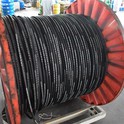
The inner diameter of a Rubber Hose EN857 plays a crucial role in determining its performance across various applications. As a supplier of Rubber Hose EN857, I've witnessed firsthand how this seemingly simple specification can have far - reaching impacts on the overall functionality of the hose. In this blog, I'll delve into the ways in which the inner diameter affects the performance of Rubber Hose EN857.
Flow Rate
One of the most significant ways the inner diameter influences the hose's performance is through its effect on the flow rate. The flow rate of a fluid through a hose is directly related to the cross - sectional area of the hose's interior, which is determined by the inner diameter. According to the Hagen - Poiseuille equation for laminar flow, the volumetric flow rate (Q) is proportional to the fourth power of the radius (r) of the tube (since the inner diameter d = 2r). Mathematically, (Q=\frac{\pi r^{4}\Delta P}{8\mu L}), where (\Delta P) is the pressure difference across the ends of the hose, (\mu) is the dynamic viscosity of the fluid, and L is the length of the hose.
In practical terms, a larger inner diameter allows for a higher flow rate of fluid through the hose. For example, in hydraulic systems where a large volume of hydraulic fluid needs to be transferred quickly, a Rubber Hose EN857 with a larger inner diameter is essential. If the inner diameter is too small, the flow rate will be restricted, leading to slower operation of hydraulic equipment. This can result in reduced productivity and increased wear and tear on the system components as they have to work harder to achieve the desired flow.
Pressure Drop
The inner diameter also has a direct impact on the pressure drop across the hose. Pressure drop is the decrease in pressure that occurs as a fluid flows through a hose due to friction between the fluid and the inner wall of the hose. A smaller inner diameter means that the fluid has less space to flow, and thus, it experiences more friction with the hose wall. This increased friction leads to a higher pressure drop.
In a hydraulic system, excessive pressure drop can be a major problem. It can cause a loss of efficiency, as more energy is required to maintain the desired pressure at the end - use point. Moreover, if the pressure drop is too high, it can lead to insufficient pressure at the hydraulic actuator, resulting in poor performance or even failure of the equipment. For instance, in a heavy - duty construction machine, a high - pressure drop in the Rubber Hose EN857 supplying hydraulic fluid to the boom cylinders can cause the boom to move slowly or not at all.
On the other hand, a larger inner diameter reduces the pressure drop. The fluid has more space to flow, and the friction between the fluid and the hose wall is minimized. This allows for a more efficient transfer of fluid with less energy loss, ensuring that the hydraulic system operates at its optimal performance.
Flexibility and Bend Radius
The inner diameter of the Rubber Hose EN857 can also affect its flexibility and the minimum bend radius. Generally, hoses with smaller inner diameters are more flexible than those with larger inner diameters. This is because a smaller - diameter hose has less material to bend, and the forces required to deform it are relatively lower.
In applications where the hose needs to be routed around tight corners or in confined spaces, a smaller - diameter Rubber Hose EN857 may be preferred. However, it's important to note that even though a smaller - diameter hose is more flexible, it may have a higher pressure drop, as discussed earlier. So, a balance needs to be struck between flexibility and pressure - drop requirements.
The minimum bend radius is also related to the inner diameter. A larger - diameter hose typically has a larger minimum bend radius. If the hose is bent beyond its minimum bend radius, it can cause kinking, which restricts the flow of fluid and can even damage the hose over time. Therefore, when selecting a Rubber Hose EN857 based on its inner diameter, the available space for routing and the required bend radius must be carefully considered.
Compatibility with Fittings
The inner diameter of the Rubber Hose EN857 is also crucial for ensuring compatibility with fittings. Fittings are used to connect the hose to other components in the hydraulic system, such as pumps, valves, and actuators. The size of the fitting must match the inner diameter of the hose to ensure a proper seal and a smooth flow of fluid.
If the fitting is too large for the hose's inner diameter, there will be a gap between the fitting and the hose, which can lead to leaks. On the other hand, if the fitting is too small, it may not be able to insert properly into the hose, or it may cause excessive deformation of the hose, leading to premature failure. As a supplier, I always emphasize the importance of selecting the right fittings based on the inner diameter of the Rubber Hose EN857 to ensure a reliable and efficient hydraulic system.
Impact on Different Types of Rubber Hoses
It's also worth considering how the inner - diameter effects vary across different types of Rubber Hose EN857. For example, Rubber Hose 1SC and Rubber Hose 2SC are two common types within the EN857 standard. The 1SC hose is a single - wire - braided hose, while the 2SC hose has a double - wire - braided construction.
In general, for a given inner diameter, the 2SC hose can withstand higher pressures than the 1SC hose due to its more robust construction. However, the inner - diameter effects on flow rate, pressure drop, flexibility, and fitting compatibility are similar for both types. The choice between 1SC and 2SC hoses often depends on the specific pressure requirements of the application, but the inner diameter remains a key factor in determining the overall performance of either type.
Another related type is the Rubber Hose EN856. While it has different construction and performance characteristics compared to EN857 hoses, the influence of inner diameter on flow rate, pressure drop, etc., follows similar principles. Understanding these relationships can help customers make more informed decisions when choosing the right hose for their needs.
Conclusion
In conclusion, the inner diameter of a Rubber Hose EN857 is a critical parameter that significantly affects its performance in various aspects, including flow rate, pressure drop, flexibility, bend radius, and fitting compatibility. As a supplier, I understand the importance of providing customers with accurate information about the inner - diameter options available and how they relate to the specific requirements of their applications.
Whether you're in the construction, manufacturing, or any other industry that relies on hydraulic systems, choosing the right inner diameter for your Rubber Hose EN857 is essential for ensuring optimal performance, efficiency, and reliability of your equipment. If you're interested in learning more about our Rubber Hose EN857 products or have specific requirements for your application, I encourage you to contact us for a detailed discussion and to explore the best solutions for your needs.


References
- White, F. M. (2006). Fluid Mechanics. McGraw - Hill.
- ISO 11237:2019. Rubber and plastics hoses and hose assemblies - Vocabulary.
- EN 857:2016. Rubber - covered hydraulic hoses and hose assemblies - Specification for four - wire - braided types.