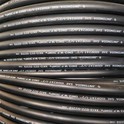
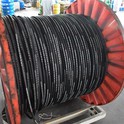
Hey there! As a supplier of RUBBER Hose SAE R12, I often get asked if this type of hose has good resilience. Well, let's dive right into it and find out!
First off, what do we mean by "resilience" when it comes to rubber hoses? Resilience refers to the hose's ability to return to its original shape after being deformed. This is super important in a lot of applications, especially in hydraulic systems where hoses are constantly under pressure and may get bent, twisted, or stretched.
The RUBBER Hose SAE R12 is designed with some pretty cool features that contribute to its resilience. It typically has a synthetic rubber tube that's resistant to a wide range of hydraulic fluids. This tube is then reinforced with multiple layers of high - tensile steel wire braid. These wire braids act like a strong skeleton for the hose, giving it the strength to withstand high pressures without losing its shape easily.
Let's talk about the pressure ratings. The SAE R12 hose is built to handle high - pressure hydraulic applications. It can usually withstand working pressures up to around 35 - 50 MPa (megapascals), depending on the specific size and construction. When a hose is under such high pressure, it's going to get pushed and pulled from all directions. But the R12's construction allows it to resist deformation. Even when the pressure is on, the wire braids keep the hose from bulging or kinking. And once the pressure is released, the hose quickly bounces back to its normal shape.
Another factor that affects resilience is flexibility. The RUBBER Hose SAE R12 is designed to be flexible enough to be installed in various setups. This flexibility is important because it means the hose can be bent and routed around obstacles without getting damaged. A flexible hose is less likely to develop permanent kinks or cracks, which would otherwise reduce its resilience. When you bend an SAE R12 hose, the wire braids and the rubber material work together. The wire braids prevent the hose from collapsing in on itself, while the rubber provides a bit of give so that the bend can be made without causing too much stress on the hose.
In comparison to some other types of hoses, like the RUBBER Hose SAE R16, the SAE R12 has its own unique advantages in terms of resilience. The SAE R16 is also a high - pressure hose, but it may have a different construction in terms of the number of wire braids or the type of rubber used. The R12's design is more focused on a balance between high - pressure resistance and flexibility, which in turn contributes to its good resilience.
The RUBBER Hose SAE R2AT is another option in the market. It's often used in medium - pressure applications. Compared to the R2AT, the SAE R12 is built for higher pressures. This means that the R12 has a more robust construction, which generally leads to better resilience. The extra wire braids and the thicker rubber layers in the R12 make it more capable of withstanding the rigors of high - pressure use and returning to its original shape.


Then there's the RUBBER Hose SAE R13. The R13 is a thermoplastic hose, which has a different material makeup compared to the rubber - based SAE R12. While the R13 has its own set of advantages, such as being lighter and more chemically resistant in some cases, the SAE R12's resilience is often better in high - pressure, mechanical stress situations. The rubber and wire braid combination in the R12 gives it a more "springy" quality that helps it recover from deformation.
Now, let's talk about real - world applications. In industries like construction, mining, and agriculture, hydraulic systems are everywhere. In a construction equipment like a hydraulic excavator, the RUBBER Hose SAE R12 is used to transfer hydraulic fluid to power the various moving parts. These parts are constantly in motion, and the hoses are subjected to a lot of vibration, pressure changes, and bending. The good resilience of the SAE R12 means that it can handle these conditions day in and day out. It won't start to sag or develop cracks easily, which is crucial for the long - term performance of the equipment.
In mining operations, where the environment is harsh and the equipment is under extreme stress, the SAE R12 hoses prove their worth. They can withstand the high - pressure hydraulic systems used in drills, loaders, and other machinery. The resilience of these hoses ensures that there are fewer leaks and failures, which is essential for safety and efficiency in a mining setting.
Agricultural machinery also benefits from the R12's resilience. Tractors, combines, and other farm equipment use hydraulic systems to operate functions like steering, lifting, and powering attachments. The SAE R12 hoses can be bent and routed around the complex machinery without losing their shape. And they can handle the pressure changes that occur during normal operation, making them a reliable choice for farmers.
But it's not just about the initial performance. The RUBBER Hose SAE R12 also has good long - term resilience. With proper installation and maintenance, these hoses can last a long time. Regular inspections to check for signs of wear, such as abrasion on the outer cover or damage to the wire braids, can help keep the hose in top shape. And if there are any minor issues, they can be addressed before they turn into major problems that would affect the hose's resilience.
In conclusion, the RUBBER Hose SAE R12 definitely has good resilience. Its construction, with the synthetic rubber tube and wire braids, gives it the strength to withstand high pressures and resist deformation. Its flexibility allows it to be installed in various setups without getting damaged. And in real - world applications, it has proven to be a reliable choice in industries where hydraulic systems are crucial.
If you're in the market for high - quality hydraulic hoses with excellent resilience, I'd highly recommend considering the RUBBER Hose SAE R12. Whether you're in construction, mining, agriculture, or any other industry that uses hydraulic systems, these hoses can meet your needs. If you're interested in learning more or making a purchase, feel free to reach out and start a discussion about your specific requirements.
References:
- Hydraulic Hose Handbook, Industry Standard Publications
- Technical Manuals from SAE International on Hydraulic Hose Standards