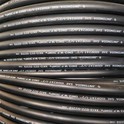
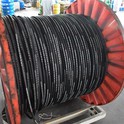
Hey there! As a rubber hose supplier, I often get asked about the weight of rubber hoses per unit length. It's a crucial question, especially for those in industries where weight can impact installation, transportation, and overall performance. So, let's dive right into it and break down what affects the weight of rubber hoses and how you can figure out what you're dealing with.
First off, it's important to understand that the weight of a rubber hose per unit length isn't a one - size - fits - all answer. There are several factors that come into play.
1. Material Composition
The type of rubber used in the hose is a major factor. Different rubbers have different densities, which directly affect the weight. For example, natural rubber is relatively lightweight compared to some synthetic rubbers like neoprene or nitrile. Natural rubber has a density of around 0.9 - 0.93 g/cm³, while neoprene has a density of about 1.23 - 1.25 g/cm³. This means that for two hoses of the same size, one made of natural rubber and the other of neoprene, the neoprene hose will be heavier.
If you're looking for a rubber hose for hot water applications, you might want to check out our Rubber Hose Pipe for Hot Water. These hoses are made from materials that can withstand high temperatures, and the material choice will also influence their weight.
2. Hose Size
The diameter and wall thickness of the hose play a huge role in determining its weight. A hose with a larger diameter and thicker walls will naturally weigh more per unit length than a smaller, thinner - walled hose. Think about it like this: a big, fat garden hose is going to be heavier than a tiny, thin - walled hose used for a small - scale industrial application.
Let's say you're comparing two hoses. Hose A has an inner diameter of 1 inch and a wall thickness of 0.1 inches, while Hose B has an inner diameter of 2 inches and a wall thickness of 0.2 inches. Even if they're made of the same material, Hose B is going to be significantly heavier because there's more rubber in it.
3. Reinforcement
Many rubber hoses are reinforced with materials like braided or spiral - wound fibers (such as polyester, nylon, or steel) to increase their strength and pressure - handling capabilities. The type and amount of reinforcement also affect the weight. Steel - reinforced hoses are heavier than those reinforced with polyester or nylon.
For high - pressure applications, we often recommend our RUBBER Hose SAE J517. These hoses are reinforced to meet specific industry standards, and the reinforcement adds to their overall weight.
How to Calculate the Weight
If you want to get a rough estimate of the weight of a rubber hose per unit length, you can use a simple formula. First, you need to know the volume of the rubber in the hose. The volume of a cylindrical hose can be calculated using the formula for the volume of a cylinder: V = πh(R² - r²), where h is the length of the hose, R is the outer radius, and r is the inner radius.
Once you have the volume, you multiply it by the density of the rubber material. For example, if you have a hose with an inner radius of 1 cm, an outer radius of 1.2 cm, and a length of 1 meter (100 cm), and the rubber has a density of 1 g/cm³:
First, calculate the volume:
V = π×100×((1.2)² - 1²)
V = π×100×(1.44 - 1)
V = π×100×0.44
V ≈ 138.23 cm³


Then, calculate the weight:
Weight = Volume×Density
Weight = 138.23×1 = 138.23 grams
Keep in mind that this is a simplified calculation and doesn't take into account the weight of any reinforcement.
Applications and Weight Considerations
In different applications, the weight of the rubber hose can be a critical factor. In automotive applications, for example, lightweight hoses are preferred to reduce the overall weight of the vehicle, which can improve fuel efficiency. On the other hand, in heavy - duty industrial applications like mining or construction, hoses need to be strong and durable, and the extra weight from thicker walls and stronger reinforcement might be acceptable.
If you're working in an environment where wear is a concern, our Wear - resistant Rubber Hose might be the right choice. These hoses are designed to withstand tough conditions, and while they might be a bit heavier due to their construction, they'll last longer.
Conclusion
So, as you can see, the weight of a rubber hose per unit length depends on a variety of factors, including material composition, size, and reinforcement. By understanding these factors, you can make a more informed decision when choosing a rubber hose for your specific application.
If you're in the market for rubber hoses and have questions about weight or any other aspect, don't hesitate to reach out. We're here to help you find the perfect hose for your needs. Whether you're a small - scale business or a large industrial operation, we've got the expertise and the products to meet your requirements. Let's have a chat and see how we can work together to get you the best rubber hoses for your projects.
References
- "Handbook of Rubber Technology" by A. Y. Coran
- "Rubber Materials and Products" published by the Rubber Manufacturers Association