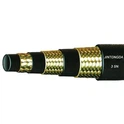
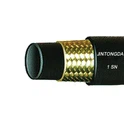
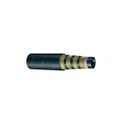
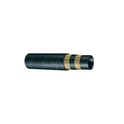
The reinforcement layer of rubber hoses is designed to improve their strength, pressure resistance, and stability. It is usually located between the inner and outer rubber layers, and sometimes may only exist on the outer side of the inner rubber layer (in the absence of an outer rubber layer). There are various types of reinforcement layers, which can be mainly divided into two categories: fiber reinforcement layers and metal reinforcement layers. Below is a detailed introduction to these types:
1. Fiber reinforcement layer:
Weaving layer: Made of fiber materials such as cotton, nylon, polyester, aramid, etc., formed through weaving process. The weaving method can be single-layer or multi-layer, such as single-layer weaving, double-layer weaving, etc. Different weaving densities and layers can be selected according to different usage requirements and pressure levels.
Spiral winding layer: The fibers are wound in a spiral form on the inner adhesive layer, which can provide good elasticity and flexibility, suitable for situations that require higher flexibility.
Fabric layer: a structure similar to fabric, reinforced by interweaving warp and weft, commonly found in hoses that require high strength and durability.
2. Metal reinforcement layer:
Steel wire weaving layer: using fine steel wire for plain or diagonal weaving, it can provide extremely high compressive strength and is suitable for use in high-pressure environments, such as hoses in hydraulic systems.
Steel wire winding layer: Unlike weaving, steel wire is tightly wound in a spiral manner, which can withstand higher pressure and provide better pulse resistance.
Steel wire+fiber hybrid reinforcement: In some special applications, it may be combined with metal wire and fiber materials to achieve specific performance requirements, such as situations that require both high strength and good flexibility.
Each type of reinforcement layer has its specific application scenario, and the appropriate type of reinforcement layer depends on factors such as the working pressure of the hose, the conveying medium, the usage environment, and the expected flexibility. The correct reinforcement layer design can maintain the structural integrity of rubber hoses under various harsh conditions, ensuring safe and effective completion of fluid or gas transmission tasks.